

A cyberpunk-inspired, zero-knowledge secure messaging and peer-to-peer file sharing platform with self-destructing messages and client-side encryption.
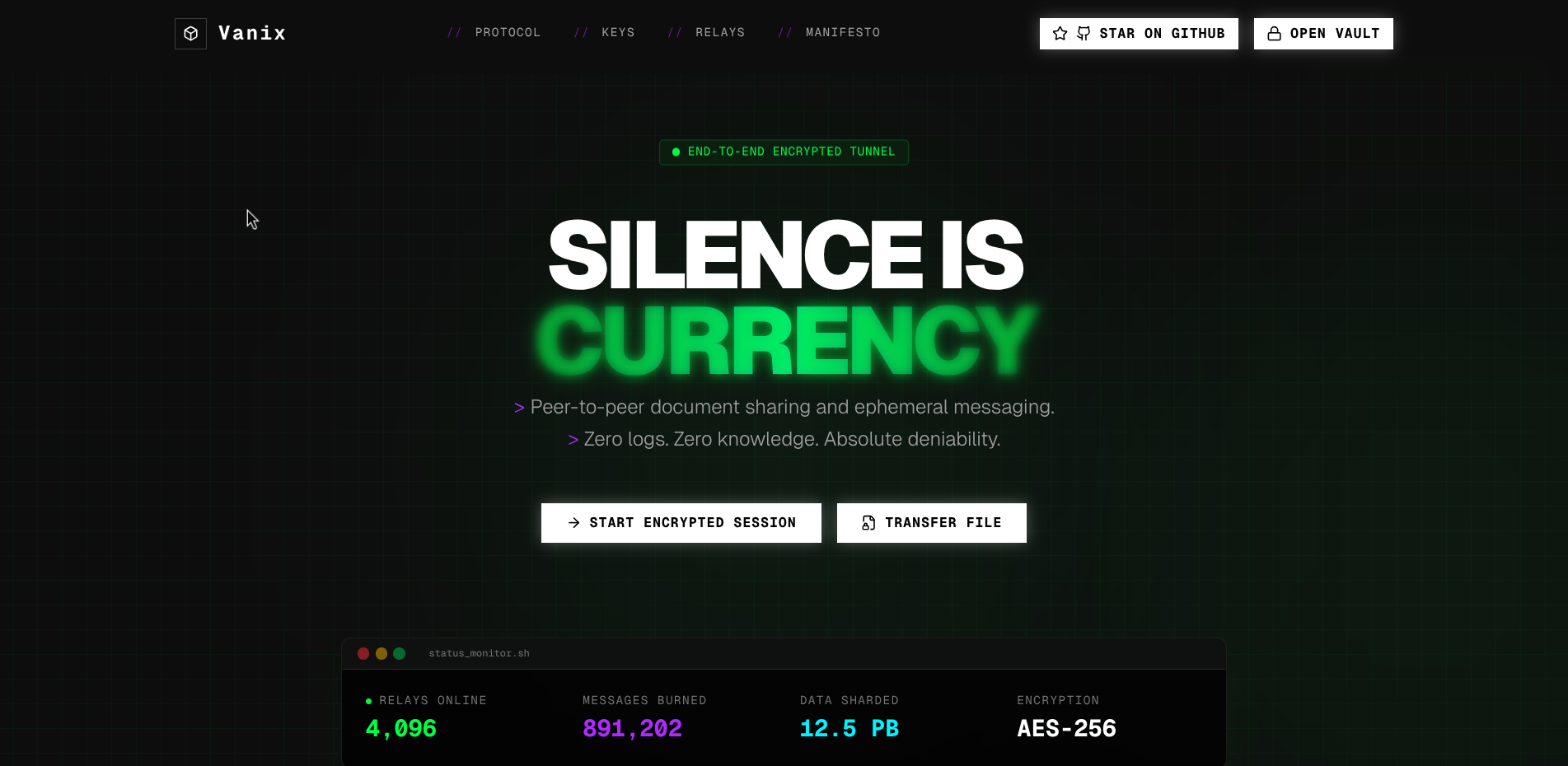
Vanix
A cyberpunk-themed secure communication platform combining self-destructing encrypted messaging with true peer-to-peer file sharing, built on a zero-knowledge architecture where the server never sees plaintext.
About The Project
I built Vanix because digital privacy felt like a luxury rather than a right, and existing secure messaging solutions were either too complex or not secure enough. Vanix combines ephemeral, end-to-end encrypted messaging with direct browser-to-browser file transfer, so neither messages nor files ever touch a server in readable form.
Key Features
- Self-destructing encrypted messages with view limits
- Peer-to-peer file sharing via WebRTC with no size limits
- Client-side AES-GCM-256 encryption before transmission
- Ephemeral links with keys embedded in URL fragments
- Real-time chunked file transfer with progress tracking
- Zero-knowledge architecture — server never sees plaintext
Development Progress
Overall Progress90%
Core messaging and P2P file sharing are complete. Final touches remain on UI polish, deployment automation, and steganography features.
Technology Stack
Motivation
The idea sparked from growing concerns about digital surveillance and the lack of truly private communication tools. I wanted to build something that felt like it belonged in a cyberpunk movie but was actually secure and could handle both messages and large files privately.
- Frustrated by file sharing services that scan and store your uploads
- Wanted true peer-to-peer transfer without intermediary servers
- Needed both secure messaging and file sharing in one platform
- Inspired by cyberpunk aesthetics and the philosophy that "silence is currency"
Development Journey
- Started with cyberpunk UI design and Next.js architecture.
- Implemented client-side AES-GCM encryption using the Web Crypto API.
- Built a WebRTC peer connection system with proper STUN/TURN servers.
- Added chunked file transfer with real-time progress tracking.
- Integrated Socket.io for WebRTC signaling and connection management.
- Currently polishing the deployment pipeline and adding steganography.
Problems Faced
-
WebRTC NAT Traversal : Implementing reliable peer-to-peer connections across different network configurations required proper STUN/TURN server setup and connection fallbacks.
-
Large File Streaming : Chunking large files while maintaining end-to-end encryption and providing real-time progress updates without overwhelming the WebRTC data channel.
-
Socket Signaling Coordination : Synchronizing WebRTC offer/answer exchange, ICE candidates, and peer state using Socket.io while gracefully handling reconnections and signaling failures.
-
Browser Memory Management : Processing large files for encryption and decryption efficiently without exhausting browser memory or degrading application performance.
Key Learnings
-
WebRTC Mastery : Gained a deep understanding of peer-to-peer networking, ICE candidates, STUN/TURN servers, and the challenges of establishing reliable browser-to-browser connections.
-
Real-time Systems : Learned to coordinate complex application state across multiple clients using Socket.io while maintaining synchronization, reliability, and security.
-
Performance Optimization : Explored techniques for efficiently encrypting, streaming, and transferring large files without sacrificing responsiveness or user experience.
-
Security Architecture : Designed a zero-knowledge system where encryption happens entirely on the client, ensuring that servers never have access to user data in plaintext.