

An intelligent AI-agent command-line assistant that combines OpenAI's language models with a structured reasoning framework to autonomously plan and execute development tasks.
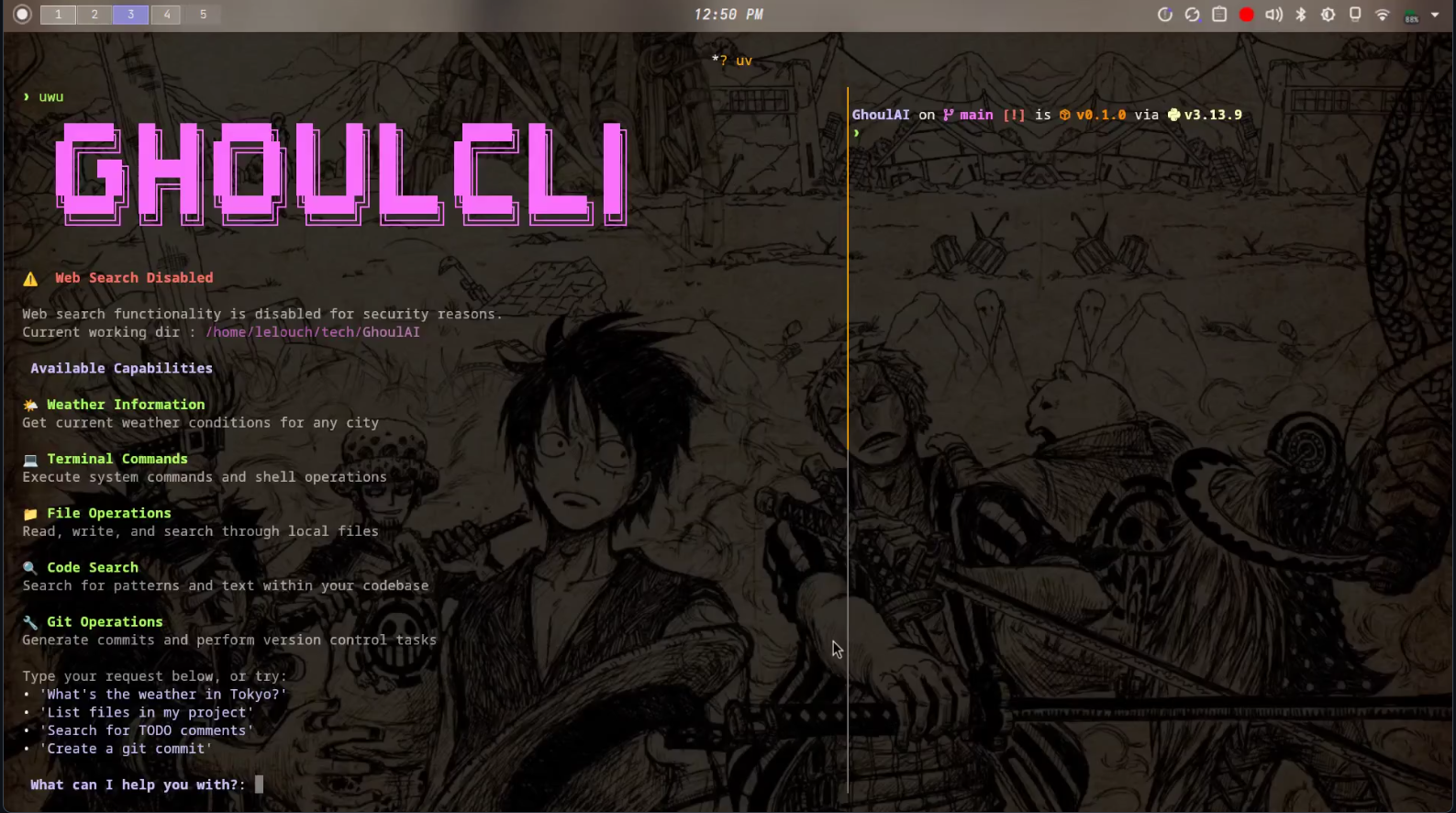
GhoulAI
An intelligent AI-Agent command-line assistant with autonomous reasoning capabilities.
About The Project
GhoulAI is a command-line AI agent that combines OpenAI's language models with a structured reasoning framework to accomplish tasks through natural language. From checking the weather to running full development workflows, it analyzes intent, plans a sequence of actions, executes them through a tool suite, and self-corrects when something fails — rather than just forwarding a prompt straight to a single tool call.
Key Features
- Multi-phase autonomous reasoning loop: Start → Plan → Action → Observe → Result
- Deep intent analysis and strategic task breakdown before acting
- Self-correcting execution with built-in error handling
- Real-time weather lookups for any city
- Terminal command execution and shell operations
- File reading, searching, and codebase analysis
- Code search across project files for patterns and text
- Git integration for staging, committing, and version control tasks
- Docker container orchestration support
- File writing and editing — creating, modifying, and refactoring files directly
Technology Stack
- Python 3.13+
- OpenAI API
- Rich (terminal UI)
- Requests
Architecture
GhoulAI is organized around a small set of focused modules: an agent.py handling branding and intro, a setup.py running the main conversation loop and AI interaction, a tools.py holding all available tool implementations, a prompt.py defining the system prompt and overall agent behavior, and a helpers.py for UI display utilities. The reasoning loop itself walks through distinct phases — understanding what the user wants, forming a plan, executing a tool call, observing the result, and reporting back — rather than treating each user message as a single isolated request.
Safety & Security
- Command execution has a hard 30-second timeout to prevent runaway processes
- API keys are managed entirely through environment variables, never hardcoded
- Agent-to-tool communication follows a structured JSON protocol
- Web search is deliberately disabled as a security boundary
Example Workflows
GhoulAI handles requests ranging from simple lookups to multi-step development tasks — checking weather for a city, searching a codebase for TODO comments, scaffolding a full React app with Vite, or staging and committing multiple files with individually generated commit messages — all through the same plan-act-observe loop.
Problems Faced
-
Structuring Autonomous Reasoning : Getting an LLM to reliably plan before acting, rather than jumping straight to a tool call, required building an explicit phase structure (Start → Plan → Action → Observe → Result) into the prompt and loop logic rather than relying on the model to self-organize.
-
Balancing Capability Against Safety : Giving the agent real terminal, file-system, and git access meant every capability had to be paired with a safety constraint — command timeouts, restricted scopes, and deliberately disabling web search to keep the blast radius of any single action bounded.
-
Designing a Reliable Tool Protocol : Coordinating between the LLM's natural-language reasoning and actual function execution required a structured JSON communication protocol so tool calls and their results could be parsed and acted on deterministically.
Key Learnings
-
Explicit Phases Beat Implicit Reasoning : Forcing the agent through distinct plan/act/observe phases produced far more reliable behavior than expecting a single model call to reason, act, and self-correct all at once.
-
Tool Design Is an Extension Point, Not an Afterthought : Structuring
tools.pyso new tools can be added with a simple function plus a registration entry made the agent meaningfully extensible without touching the core reasoning loop. -
Guardrails Matter More As Capability Grows : The more real-world actions an agent can take (running commands, editing files, committing code), the more its safety constraints — timeouts, scoped permissions, disabled risky tools — become as important as its actual intelligence.